If you have not already done so, or if you are new, I recommend starting with Chapter 1. This is a linear story and will make a lot more sense read as a whole. Please leave a like, comment, or subscribe to my blog to get notifications when a new chapter is published. If I get 100 views on a single post of One More Life, I will self-publish a digital and printed copy with an exclusive Epilogue. If you only missed the last post, you can read Chapter 8 here.
Fiction: One More Life 09
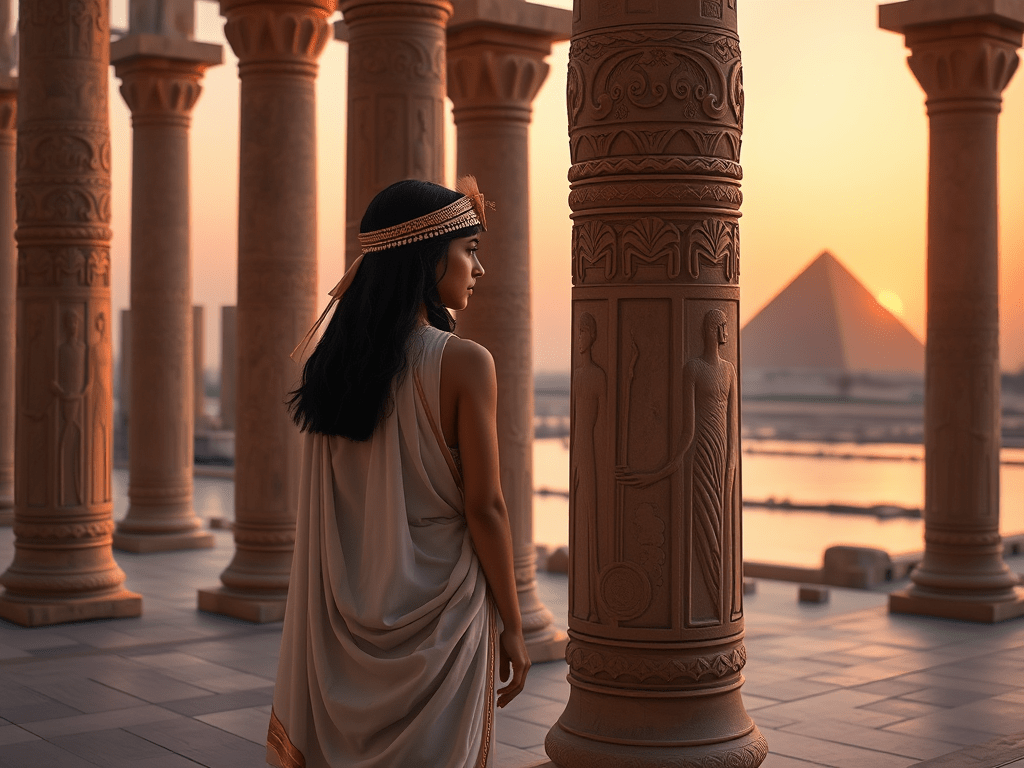
The morning sun dawned blinding and bright “as Ra intended” to borrow a favorite phrase from her father. After three days of stillness and black, it was a welcome sight. Rana walked the marbled platform amidst the carved columns overlooking the banks of the Nile. Finally, she slumped with her back against a column and gazed out over the water. Behind her stood the carved opulence of Egypt. Pharaoh’s palace displayed the finest craftsmanship in all the world. Artisans of every craft had poured into it a thousand year’s worth of skill. One could study it for a decade and still miss any number of intricacies. But her eyes were on the water, glittering in the desert sun. Even the great pyramids beyond, architectural impossibilities raised from the silken desert sand, could not capture her attention. Certainly, the greatest men in the world had built the empire of her youth. Yet today it swayed on unsteady legs, its wealth in tatters, ravaged by the wrath of the Hebrew god. Horus in all his splendor stood cold and speechless in his temple. Isis, too, was mute. Even Ra had been chased from his throne in the heavens returning only, at the behest of Moses and his god.
.
Perhaps the Hebrew god, whom Nathan said created all things, including the sun and the river was truly over and above all the gods of Egypt. Nathan said there were no gods in Egypt, only statues carved by men that could not talk or answer. It seemed that he was right, for they were certainly silent now. They and their magic, the sorceries of her father and pharaoh’s magicians, had no answer to the lost prince of Egypt.
.
The mystery surrounding his disappearance had entertained her often as a little girl. It was said that he had murdered someone. Others said he had a forbidden love affair with a married woman. Some even suggested that he had gone in search of the lost eye of Horus. Nathan told her that Moses had been herding sheep in the wilderness these long years and had only returned because their god had told him to do so.
.
What an uproar he had caused! Many of pharaoh’s officials liked the Hebrew prince, but the magicians guild, men like her father, despised him and not only because he was Hebrew. Since the Hebrew prisoner, Joseph, had displaced them four-hundred years ago, the priest-magicians had devoted themselves to weakening the position of the Hebrew people. Her grandfather had grown strong in Pharaoh’s house and his whisperings had paved the way for Hebrew enslavement. But their natural enemy was not the only reason for the guild to hate Moses. Moses had demonstrated with undeniable clarity command of real power. Not the parlor tricks her father and his friends had used to command respect amongst the king’s officials. No, Moses, had commanded swarms of pests, of animals, had cursed them with boils, had commanded the weather, and now had unseated Ra himself from the sky.
.
All of that chaos roiled about her, yet it was not why she had sought this solace on the river. It is not why she stared lost into its shimmering waters. Nathan had said it would not be long now. He was her best, albeit, most unlikely friend. In the little spare time he had to command, he accompanied her, regaling her with stories of his people, of Abraham and Joseph and their God. She had used her father’s influence to get him out of work so that they could picnic on the shores of the Nile, climb the pyramids, even race horses. He insisted on working doubly hard the days she came to him, telling her it was not right that anyone should labor for him. A few weeks ago, Nathan had come to her. He told her that Moses’ return harkened the end of his time in Egypt. The entirety of his people would leave; their god had heard their cries. She had actually laughed out loud and teased him. Who could stand against the might of pharaoh, indeed of Egypt? To his everlasting credit, he had not grown angry; instead his expression had deepened with worry enough to silence her taunts. Could it be that Egypt would bow to another? It seemed so, for she was on her knees.
.
Nathan had visited her often since then, moving with a sense of urgency she couldn’t understand. This morning, it had become clear. It won’t be long now, Rana. We will leave soon. This time she did not laugh; she knew it to be true. Rana had long sensed his affections, pointedly ignoring the power of her own. So intentionally distanced from them was she, that her father had barely objected to her slave plaything, assuming she would eventually grow bored and move on. But as she gazed into the depths of that ancient stream, she was keenly aware that he was slipping away from her, like the water slipping away to the great sea never to return. And it hurt.
.
She reached out a toe, nudging the dried husk of a locust. Egypt, with its scorching sands and flourishing river valley, was her home in all its extremes. She knew of nothing else. With a sigh, she pushed herself upright and kicked the insect’s corpse into the lapping waters. Her mother would be worried.
.
She had not been home long when her father also returned. It seemed the meeting with pharaoh had not gone well. He was shoving papyri about on a table, slamming things down, actually stamping his foot, throwing a full-blown temper tantrum. He slammed his fists down on his desk, but when he caught sight of her standing in the archway of his library, he stopped short. An expression of what she could only call fear ghosted across his face as he stared at her.
.
A servant interrupted them. Nathan was here to see her. Her father’s face flashed from irritation to thoughtfulness and back again. Finally he settled into stony and solemn.
.
“Go with him,” he said in a hard voice.
.
Her eyebrows rose in astonishment–where?–but she replied respectfully, “Father?”
.
“He is here for you, is he not? Go with him,” he repeated, swallowing.
.
She bowed her head, bewildered and obedient, “Yes, Father.”
.
No sooner was she out of his sight than Nathan was there. Dressed in the woven tunic common among his people, he was more handsome than she had ever thought possible. Dark brown hair flopping tousled on his forehead and caramel eyes so alive she could never tire of them topped off his chiseled form. He took both her hands in his like limestone wrapping silk.
.
“Come away with me.” His sun-tanned face was pale, his body coiled and still as though restraining some great impulse. His voice was low, insistent.
.
“What’s happening?” She searched his face, trying to understand the change that had overtaken both him and her father. Something important had happened.
.
“You cannot stay here. You’ll die if you do. Come with me, please?” He squeezed her fingers, willing her to agree.
.
“Of course I’ll go with you. I’d go with you anywhere.” The words tumbled from her and she stilled as the simultaneous weight of their truth washed over her, alongside the freedom of acknowledgment. She would go anywhere, face anything if he was there, too. She watched relief flood him and he drew her into a tight embrace. She could feel his strength against her and felt almost giddy inside.
.
He released her, taking one hand to lead her away, down the carved steps, practically running down the near empty streets beyond.
.
“Tell me what’s happened, Nathan. Father was furious, and then he looked frightened. Then he told me to go with you,” she babbled.
.
Nathan glanced back at her, clearly understanding. “Moses threatened all of the firstborn of Egypt. He has shown us a way to prepare and cover ourselves when death comes so that my people might be spared.” His voice grew frustrated, “If pharaoh would just let us go–would he watch all of Egypt burn before he sees? He cannot fight the God of Abraham.” He looked at her and softened his countenance, “Your father, at least, is not such a fool.”
.
Understanding dawned in her. She was her father’s eldest, his firstborn. He did not despise the Hebrew more than he loved her. Deep down, he was beginning to fear the Hebrew God, too. They hurried on toward the place where Nathan dwelt with his family.
.
His mother eyed her dubiously, then apparently accepted Nathan’s determination to save an Egyptian. Nathan’s father had greeted her warmly, having met her a number of times already. He was a mammoth of a man, and would have been imposing except for his perpetual smile and twinkling eyes. No one could be in his presence and feel unwelcome. Even in the mud pits where they stamped out bricks, he had managed to produce an atmosphere of relative comfort and fun. He was even well-liked among the slavemasters. Rana resolved to help as much as possible and Nathan’s mother graciously gave her simple tasks that her young daughters could oversee.
.
As dark as the past few days had been, this night washed over them with a pervasive sense of great foreboding. The smell of roasted lamb filled the household. Despite her decided lack of an appetite, she ate her fill.
.
The shadows deepened, they all drifted to their places and lay still in their beds, she on a bedroll beside Nathan’s sisters. Far from the calm of ordinary rest, the sense of dread, the waiting, were palpable. It was midnight when the cries began. If she could have stood on the precipice of the pit of hell, all the wailing souls of the damned could not have filled her with greater dread and sorrow than she felt that night. She would remember it for as long as she lived. She could not block out the anguish of that night, but bowed her head low in prayer to the strange God who had conquered Egypt while his people only stood by and watched.
.
The relentless desert sun rose again, oblivious to the suffering beneath its rays. Nathan’s family was already bundling everything they owned on a cart. Nathan and Rana finally broke away intent to collect some of her things, to say farewell to her family. It was unspoken, but implicit. She would leave with them.
.
When she arrived at her own sprawling, luxurious home her mother and father shied away from Nathan as though the destroyer might be lurking in his very shadow. They had silently stood by, watching her gather her things. In her own chambers upstairs, she was stuffing an assortment of items into a satchel when her mother entered the room bringing her a small bundle of valuables. She had peered searching into Rana’s eyes, as though trying to memorize her face. Her father was as one defeated, slumped against the entry wall. He said nothing.
.
Rana was finishing up in her chambers, Nathan waiting chastely outside, when she heard the arrival of a man and raised voices downstairs. She and Nathan inched to the top of the stairs. In the hall stood a man she recognized as one of her father’s colleagues, a fellow magician, gesturing furiously while her father made no reply. This man had always filled her with peculiar unease. When her father noticed them and his eyes flicked up the stairs, the magician followed his gaze. The man’s bearded face registered surprise–she should not be alive. Then, with dawning comprehension and disgust as he observed the Hebrew beside her. He turned back toward her father with narrowed eyes and unveiled scorn.
.
“You traitor,” he spat. “You are a disgrace to your people, your station! Would a priest of Egypt so quickly forsake his faith?”
.
Her father’s words came out a murmur, “For her life, yes.”
.
The man’s face twisted with an aberrant ugliness as he returned his attention to her. “You would chase your slave into the desert? Chase him over the world! For all eternity, may you pursue and never be satisfied.” A shadow seemed to fill the hall as his rage reached a crescendo. His face twisted into a rictus grin that made her skin grow cold.
.
“No!” cried her father as the man spun on his heel and stormed away.
.
A chill prickled up her spine as Nathan and Rana descended the stairs and she rushed to her father’s side. He was pale and drawn, his eyes glassy. She reached for his arm searching his face in concern.
.
Finally he turned toward Nathan, “I hope the Hebrew god is able to undo this curse.” He looked at the ground then said hollowly, “Go.”
.
Rana kissed his stubbled cheek and his listless hand wetting them with her tears, but he did not respond. She did not see him clench the tears in his fist, holding them tightly until all their moisture evaporated.
.
As they descended into the street, Nathan took her hand leading her through the city.
To continue to Chapter 10, click here!
If you enjoyed this, wish to own a copy for your collection, and enjoy exclusive content, you can purchase the book here.
©2025 Noell, LLC
 Feminine 101